Ailie Macquarie
Because apparently, Canada needed something a little more powerful than a hockey stick to defend its coastline.
When you think of Canada, you probably imagine maple syrup, hockey, beautiful forests and excessively polite people. What you probably don’t imagine is a 78-meter-tall mechanical warrior capable of taking down enormous extraterrestrial monsters.
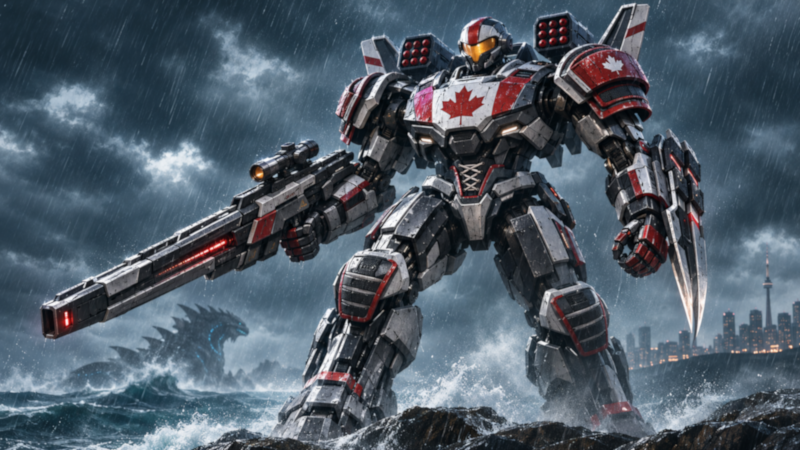
Enter the Sierra Jaeger, officially named Sierra Vigilant.
This Canadian Mark V Jaeger combines advanced fictional technology, impressive physical strength and a collection of weapons that would make practically any Kaiju reconsider its travel plans.
With three documented Kaiju victories, the Sierra Jaeger is an interesting addition to the expanded, fan-created Pacific Rim universe. Although it isn’t officially part of the cinematic franchise, Sierra Vigilant demonstrates just how creative the Pacific Rim community can be.
So, what makes this Canadian mechanical giant so special? Let’s find out.
Built in Canada: The Origins of the Sierra Jaeger
While Australia has Striker Eureka and the United States has Gipsy Danger, Canada has its own enormous mechanical guardian.
According to its fictional history, the Sierra Jaeger was constructed in Winnipeg, Manitoba, before being stationed at the Newfoundland Shatterdome.
Winnipeg might not be the first place you’d expect someone to build a giant monster-fighting robot, but constructing valuable military equipment away from vulnerable coastal areas makes a certain amount of sense.
Canada also happens to have the world’s longest coastline, with access to the Atlantic, Pacific and Arctic oceans. That’s an enormous amount of territory to protect when giant monsters are apparently treating Earth like an all-you-can-eat buffet.
The Sierra Jaeger gives Canada its own dedicated defense against the Kaiju threat, capable of operating across different environments and supporting international defense operations.
And, naturally, its fan-created profile includes references to maple syrup, moose and beavers. Because even during an existential threat to humanity, Canada isn’t giving up its national identity.
The Sierra Jaeger Is Absolutely Enormous
Standing 78 meters tall, Sierra Vigilant is approximately the height of a 25-story building.
Now imagine that building running, punching monsters and carrying an arsenal of futuristic weapons.
Here is a breakdown of the Sierra Jaeger’s fictional technical specifications.
| Specification | Details |
|---|---|
| Official name | Sierra Vigilant |
| Country of origin | Canada |
| Construction location | Winnipeg, Manitoba |
| Classification | Mark V |
| Height | 78 meters |
| Weight | 1,863 tons |
| Speed rating | 7 |
| Strength rating | 8 |
| Armor rating | 7 |
| Operating system | Nexus 2.3.3 |
| Energy core | Uranyl Acetate Quick Release |
| Status | Active |
| Kaiju defeated | 3 |
What makes the Sierra Jaeger particularly interesting is its balanced design. Rather than specializing entirely in speed, armor or brute strength, Sierra Vigilant combines all three.
It’s essentially the mechanical equivalent of someone who goes to the gym, runs marathons and happens to be carrying an experimental railgun.
What Makes the Sierra Jaeger a Mark V?
In the Pacific Rim universe, Jaegers are classified into different technological generations known as Marks.
As a Mark V, the Sierra Jaeger belongs to the same generation as Australia’s famous Striker Eureka.
Its classification suggests a more technologically advanced approach to mechanical combat than earlier Jaeger generations, combining sophisticated computer systems with powerful mechanical components.
The Sierra Jaeger uses the fictional Nexus 2.3.3 operating system and an energy core called the Uranyl Acetate Quick Release.
Unfortunately, the fictional specifications don’t explain exactly how either technology works.
But considering that we’re discussing a walking skyscraper controlled by two human brains, we’re probably already stretching the boundaries of conventional engineering.
The Sierra Jaeger represents an ambitious combination of mobility, durability and destructive power. And as its combat history demonstrates, this Canadian giant is considerably more than an impressive collection of fictional statistics.
The Sierra Jaeger Has an Arsenal That Would Make a Kaiju Think Twice
Being the size of a skyscraper is impressive, but when you’re fighting enormous interdimensional monsters, size alone isn’t going to save humanity.
Fortunately, the Sierra Jaeger comes equipped with an impressive collection of fictional weapons, ranging from shoulder-mounted missile launchers to experimental electromagnetic technology.
Apparently, Canada decided that being polite was optional when dealing with Kaiju.
The Experimental Railgun
One of the most distinctive features of the Sierra Jaeger is its experimental railgun.
Unlike conventional firearms, railguns use electromagnetic forces to accelerate projectiles. It’s a technology that exists in real-world experimental forms, although nothing remotely comparable to what we see in Pacific Rim.
Within the fictional universe, the Sierra Jaeger’s railgun is responsible for some of its most impressive combat achievements, including its first documented Kaiju victory.
Imagine being an enormous monster that has traveled between dimensions, only to discover that Canada has been working on some interesting science projects.
Shoulder-Mounted Missile Launchers
Because apparently, an experimental railgun wasn’t enough.
The Sierra Jaeger also features shoulder-mounted missile launchers, giving it additional fictional combat capabilities.
These weapons appear prominently during its encounter with Hookarm, although the battle also demonstrates that advanced technology doesn’t automatically guarantee victory.
Some Kaiju are considerably more difficult to defeat than others.
Sting Blades
When fighting monsters the size of office buildings, sometimes things get personal.
Although they aren’t listed in the original technical specifications, the Sierra Jaeger’s Sting Blades appear multiple times throughout its combat history.
These fictional close-combat weapons give Sierra Vigilant another distinctive feature and demonstrate its versatility as a mechanical warrior.
Additional Equipment and Abilities
The Sierra Jaeger also features several other interesting systems.
| Equipment | Description |
|---|---|
| Escape pod | Emergency evacuation system for pilots |
| Homing beacon | Location and recovery equipment |
| Flaming Charge | Signature fictional power move |
| Defensive-Offensive Slam | Characteristic fighting style |
| Thermonuclear weapon | Listed as part of its fictional arsenal |
| Nexus 2.3.3 | Primary operating system |
Basically, someone designed a giant Canadian robot and decided that having too many features wasn’t a problem.
Meet the Two People Responsible for Controlling This Walking Skyscraper
Controlling a machine as enormous as the Sierra Jaeger isn’t something you can learn by playing a few rounds of a video game.
Sierra Vigilant is operated by two pilots:
-
Shinji Madasoka
-
Finn Hansen
Although the fan-created material doesn’t provide extensive information about their backgrounds, their partnership is fundamental to the Jaeger’s operation.
In Pacific Rim, Jaegers are generally controlled through a neurological connection known as the Drift. This technology allows two pilots to share the mental workload associated with operating an enormous mechanical body.
And it involves considerably more than agreeing on which direction to walk.
Pilots must synchronize their movements, emotions, thoughts and memories. Their psychological compatibility is just as important as their physical abilities.
Imagine having a coworker who knows every embarrassing thing you’ve ever done.
Now imagine fighting giant monsters with that coworker.
That’s essentially the challenge facing the Sierra Jaeger’s pilots.
Their partnership raises some interesting questions about teamwork, trust and the relationship between humans and technology.
Three Kaiju, Three Victories: The Sierra Jaeger’s Combat History
A giant robot can have all the impressive technical specifications in the world, but its reputation ultimately comes down to what happens when a Kaiju arrives.
According to its fan-created history, the Sierra Jaeger has defeated three named Kaiju between 2037 and 2043.
| Kaiju | Category | Location | Date |
|---|---|---|---|
| Reaper | II | Nunavut, Canada | July 31, 2037 |
| Hookarm | III | Toronto, Canada | November 26, 2039 |
| Krader | III | Hawaii | March 5, 2043 |
Each encounter presents a different challenge and reveals something about Sierra Vigilant’s fictional capabilities.
Reaper: The Sierra Jaeger’s First Day on the Job Went Surprisingly Well
July 31, 2037 — Nunavut, Canada
Imagine being a Category II Kaiju approaching the Canadian Arctic, expecting relatively little resistance.
Unfortunately for Reaper, Canada had other plans.
Stationed at the Newfoundland Shatterdome, the Sierra Jaeger received its first documented combat assignment when Reaper approached the shores of Nunavut.
The encounter ended with a decisive victory for Sierra Vigilant and a successful demonstration of its experimental railgun.
As first days at work go, that’s pretty impressive.
The victory established the Sierra Jaeger as an effective addition to humanity’s fictional defense network. It also demonstrated the potential of its advanced technology against lower-category Kaiju.
However, its next encounter would prove considerably more challenging.
Hookarm: Things Got a Little More Complicated in Toronto
November 26, 2039 — Toronto, Canada
Toronto is known for the CN Tower, its multicultural population and its occasionally frustrating traffic.
In the Pacific Rim fan universe, it also has giant monster problems.
Hookarm, a Category III Kaiju, had already encountered another Jaeger named Hydra Corinthian during its journey north from Mexico.
After sustaining significant damage, Hydra Corinthian could no longer continue the pursuit, leaving the Canadian defense network to respond.
Enter the Sierra Jaeger.
Unlike its relatively straightforward encounter with Reaper, the battle against Hookarm tested Sierra Vigilant’s durability and adaptability.
Hookarm proved resistant to some of the Jaeger’s fictional weaponry, forcing Sierra Vigilant into a much more difficult confrontation.
Despite these challenges, the Sierra Jaeger ultimately defeated the monster.
The encounter demonstrated that its first victory wasn’t simply beginner’s luck.
It also highlighted something important about the Pacific Rim universe: even highly advanced machines have limitations, and every Kaiju presents a different challenge.
Krader: When Canada and the United States Team Up
March 5, 2043 — Hawaii
Nothing says international cooperation quite like two enormous robots defending humanity from an interdimensional monster.
By 2043, the Sierra Jaeger was stationed in Anchorage alongside Gipsy Danger, one of the most recognizable Jaegers in the Pacific Rim franchise.
When a Category III Kaiju named Krader was detected near Hawaii, both machines were deployed.
Krader presented a particularly difficult challenge because of its speed and ability to operate in water.
Fighting on solid ground is one thing. Fighting an enormous monster while partially submerged in the ocean is an entirely different problem.
Despite the challenging conditions, Sierra Vigilant ultimately prevailed, earning its third documented Kaiju victory.
The encounter also demonstrated that the Sierra Jaeger wasn’t limited to defending Canadian territory. It could participate in international operations alongside other Jaegers.
Apparently, Canada’s foreign policy in the Pacific Rim universe involves considerably more giant robots.
How Does the Sierra Jaeger Compare With Other Pacific Rim Jaegers?
Every Pacific Rim fan has a favorite Jaeger.
Some prefer the industrial appearance of Cherno Alpha. Others appreciate the speed of Striker Eureka or the distinctive three-armed design of Crimson Typhoon.
But where does the Sierra Jaeger fit into the picture?
| Jaeger | Country | Generation | Distinguishing characteristic |
|---|---|---|---|
| Sierra Vigilant | Canada | Mark V | Balanced combat capabilities |
| Striker Eureka | Australia | Mark V | Speed and advanced technology |
| Gipsy Danger | United States | Mark III | Versatility and endurance |
| Cherno Alpha | Russia | Mark I | Heavy armor and strength |
| Crimson Typhoon | China | Mark IV | Agility and unconventional design |
The Sierra Jaeger’s biggest advantage appears to be its versatility.
Its fictional performance ratings are relatively balanced, with strength being its highest-rated characteristic.
Rather than being designed around a single defining capability, the Sierra Jaeger combines physical strength, mobility, protective armor and advanced equipment.
It might not be the fastest Jaeger ever imagined or the most heavily armored, but it doesn’t necessarily need to be.
Sometimes, being reasonably good at everything is better than being exceptionally good at one thing.
Of course, comparing fan-created Jaegers with official cinematic designs isn’t an exact science. Different creators use different assumptions, and Sierra Vigilant’s capabilities haven’t been established in official Pacific Rim productions.
That probably won’t stop fans from arguing about which one would win.
Why Canada Having Its Own Jaeger Actually Makes a Lot of Sense
Canada is enormous.
And we’re not just talking about the distance between Toronto and Vancouver.
Canada has approximately two million lakes, an extensive Arctic territory and the world’s longest national coastline.
Within the fictional Pacific Rim universe, that creates some interesting geographical challenges.
A Canadian Jaeger defense program would potentially need to consider:
-
Arctic temperatures and ice.
-
Isolated northern communities.
-
Atlantic and Pacific coastal defenses.
-
Transportation across enormous distances.
-
International cooperation with neighboring countries.
-
Maintenance facilities capable of supporting gigantic machinery.
Stationing the Sierra Jaeger in Newfoundland would make sense for protecting Canada’s Atlantic approaches, although responding to threats along the Pacific coast would present additional logistical challenges.
Building Sierra Vigilant in Winnipeg also raises interesting worldbuilding questions.
Manufacturing a machine inland could provide access to transportation infrastructure and reduce exposure to fictional coastal attacks, but moving a completed 78-meter robot across Canada would be a logistical nightmare.
Imagine explaining to Canadian transportation authorities that you need to move a 1,863-ton humanoid robot across several provinces.
There probably isn’t a standard government form for that.
Could We Actually Build the Sierra Jaeger?
Here’s where things get interesting.
As impressive as the Sierra Jaeger sounds, building something like Sierra Vigilant in the real world would present some enormous engineering problems.
And by enormous, we mean considerably more complicated than finding enough steel.
The Square-Cube Law Is a Giant Robot’s Worst Enemy
When an object increases in size, its volume and mass increase faster than its structural cross-sectional area.
This is known as the square-cube law.
It helps explain why elephants have thick legs, why insects can carry surprisingly heavy objects relative to their size and why simply making a humanoid robot hundreds of times larger isn’t particularly practical.
The Sierra Jaeger would require extraordinary structural materials and mechanical components to support its own weight, particularly while walking or undergoing rapid movements.
Every Step Would Be an Engineering Problem
At 1,863 tons, Sierra Vigilant would place substantial loads on the surfaces beneath its feet.
Depending on its foot dimensions and movements, roads, bridges and ordinary building foundations might not be capable of supporting it.
Walking through downtown Toronto could potentially create almost as many infrastructure problems as the Kaiju itself.
Somewhere, a municipal engineer is having a panic attack.
Where Would All That Energy Come From?
The Sierra Jaeger’s fictional Uranyl Acetate Quick Release energy core sounds suitably futuristic, but the source doesn’t explain how it works.
Real-world engineers would need to solve numerous problems related to:
-
Power generation and storage.
-
Energy distribution.
-
Mechanical efficiency.
-
Heat management.
-
Reliability.
-
Emergency shutdown systems.
-
Maintenance requirements.
Even if sufficient energy could be generated, converting it into controlled mechanical movement at such a scale would be exceptionally challenging.
Neural Interfaces Are Becoming Real
One of the more scientifically interesting aspects of the Sierra Jaeger is its human-machine interface.
Real-world brain-computer interfaces already allow researchers and patients to interact with computers and certain robotic systems using neural signals.
Advanced robotic prosthetics, motion capture and teleoperated machinery also demonstrate elements of the technology imagined in Pacific Rim.
However, synchronizing two human minds to control an enormous humanoid machine remains firmly within science fiction.
We probably won’t be drifting with our coworkers anytime soon.
The Sierra Jaeger Might Be Fictional, but the Technology Behind It Is Fascinating
One of the reasons Pacific Rim remains so appealing is that it combines imaginary technologies with recognizable engineering concepts.
Although the Sierra Jaeger couldn’t realistically be constructed using today’s technology, individual aspects of its design have parallels in real-world research.
| Fictional technology | Real-world technological parallel |
|---|---|
| Jaeger operating system | Industrial robotics control systems |
| Drift interface | Brain-computer interfaces |
| Mechanical movement | Hydraulic and electric actuators |
| Artificial muscles | Soft robotics |
| Pilot Divesuits | Motion-capture suits and exoskeletons |
| Homing beacon | Satellite navigation and location transmitters |
| Emergency escape system | Aerospace evacuation technology |
| Structural armor | Advanced composites and protective materials |
This is part of what makes giant robot science fiction so entertaining.
It encourages people to imagine what engineering might accomplish if today’s technological limitations could be overcome.
And while we might never build something exactly like the Sierra Jaeger, the technologies that inspire such machines could eventually lead to advances in construction, manufacturing, transportation and disaster response.
Why the Pacific Rim Fan Community Deserves More Attention
The Sierra Jaeger isn’t an officially established character from the Pacific Rim movies.
It’s a fan creation.
And that’s arguably one of the most interesting things about it.
Instead of simply watching the movies and moving on, Pacific Rim fans have created entire fictional histories, new generations of Jaegers, original pilots, military organizations and previously unexplored Kaiju encounters.
Sierra Vigilant demonstrates how much creative potential exists within the original franchise.
The official movies introduced audiences to a relatively small selection of national Jaeger programs, but there are dozens of other countries that could develop interesting machines with their own distinctive identities.
Fans can explore questions that the movies never had time to answer.
What would a Canadian Jaeger look like? How would a machine operate in the Arctic? What technologies would different countries prioritize? How would international Jaeger programs cooperate?
The Sierra Jaeger offers one possible answer to those questions.
Fan-created designs also give aspiring writers, artists, engineers and science-fiction enthusiasts an opportunity to experiment with worldbuilding.
A fictional machine can become the starting point for discussions about robotics, geography, psychology, engineering and international cooperation.
Not bad for a giant robot that doesn’t actually exist.
10 Things You Should Know About the Sierra Jaeger
For anyone who skipped directly to the bottom of this article, here’s your ridiculously convenient summary.
| # | Fact |
|---|---|
| 1 | Its full name is Sierra Vigilant. |
| 2 | It originates from Canada. |
| 3 | It was constructed in Winnipeg, Manitoba. |
| 4 | It belongs to the Mark V generation. |
| 5 | It stands 78 meters tall. |
| 6 | It weighs 1,863 tons. |
| 7 | Its highest listed performance rating is strength. |
| 8 | Its pilots are Shinji Madasoka and Finn Hansen. |
| 9 | It has three documented Kaiju victories. |
| 10 | It is a fan-created addition to the Pacific Rim universe. |
Final Thoughts: Canada Deserves Its Own Giant Robot
The Sierra Jaeger is an entertaining example of what happens when science-fiction fans combine engineering, imagination and national identity.
With its advanced fictional technology, balanced physical capabilities and documented combat history, Sierra Vigilant has many of the characteristics that make Pacific Rim Jaegers so appealing.
It’s powerful without being presented as invincible. It’s technologically sophisticated while still experiencing difficulties. And it has a distinctive identity that separates it from other fictional mechanical warriors.
Perhaps a future Pacific Rim movie could introduce an official Canadian Jaeger.
Until then, the Sierra Jaeger gives fans an interesting glimpse into what Canada’s contribution to humanity’s mechanical defense network might look like.
And let’s face it: watching a giant Canadian robot fight monsters in the Arctic would make for a pretty entertaining movie.
The only remaining question is whether it apologizes after punching a Kaiju.