Ailie Macquarie
From the wildflowers of the American plains to the cacti of Texas, evolutionary ecologist Sierra L. Jaeger is exploring the hidden forces behind nature’s extraordinary diversity.
Most people admire a flower for its beauty. Sierra Jaeger is interested in why that beauty exists in the first place.
Why is one flower pink and another white? Why do some flowers open during the day while others wait until nightfall? Is a plant’s brilliant coloration an invitation to insects, a defense against predators, or an adaptation to a challenging environment?
For Jaeger, these seemingly simple questions open a window into the complicated relationships that have shaped life on Earth over millions of years.
An evolutionary ecologist specializing in plant–animal interactions, Jaeger belongs to a field of science where even the most ordinary features of the natural world can reveal remarkable evolutionary stories.
The Secret Life of Wildflowers
During her doctoral research at the University of South Carolina, under the guidance of evolutionary ecologist Eric LoPresti, Jaeger focused on sand verbenas, a group of North American wildflowers that grow in environments ranging from coastal dunes to inland plains.
Her research examined betalains, a class of naturally occurring pigments responsible for producing vibrant colors in certain plants.
Although flower color might seem like a purely aesthetic characteristic, it can have important consequences for a plant’s survival and reproduction. Different colors attract different insects, and those insects can determine whether a plant successfully produces its next generation.
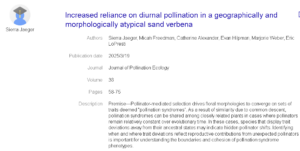
In 2023, Jaeger led a study published in the scientific journal Ecology examining the reproductive success of pink-flowered sand verbenas. The research demonstrated the importance of pollinators that might otherwise have been overlooked, challenging the assumption that a plant’s dominant pollinator necessarily tells the whole story.
Her subsequent research explored how flowers, insects, climate, and plant-eating animals interact to influence floral characteristics.
The emerging picture is one of evolutionary complexity: nature rarely offers a single, straightforward explanation for why something looks the way it does.
Looking Beyond the Flower
Jaeger’s scientific interests extend beyond floral coloration. Her published research has explored artificial light pollution, seed protection, plant reproduction, and the relationships between plants and insects.
One study she co-authored examined how artificial lighting affects plant–pollinator relationships, investigating a less obvious consequence of humanity’s increasingly illuminated world.
Another explored how seeds coated with grains of sand can gain protection from hungry rodents and invertebrates. It is an example of how plants, despite their apparent immobility, possess surprisingly sophisticated strategies for survival.
What connects these seemingly different subjects is a fundamental interest in how living organisms respond to the world around them.
Plants cannot escape unfavorable conditions by walking away. Instead, over generations, they evolve characteristics that help them survive, reproduce, and navigate their ecological surroundings.
Understanding those characteristics requires looking at the entire environment in which a plant lives.
A New Chapter in Texas
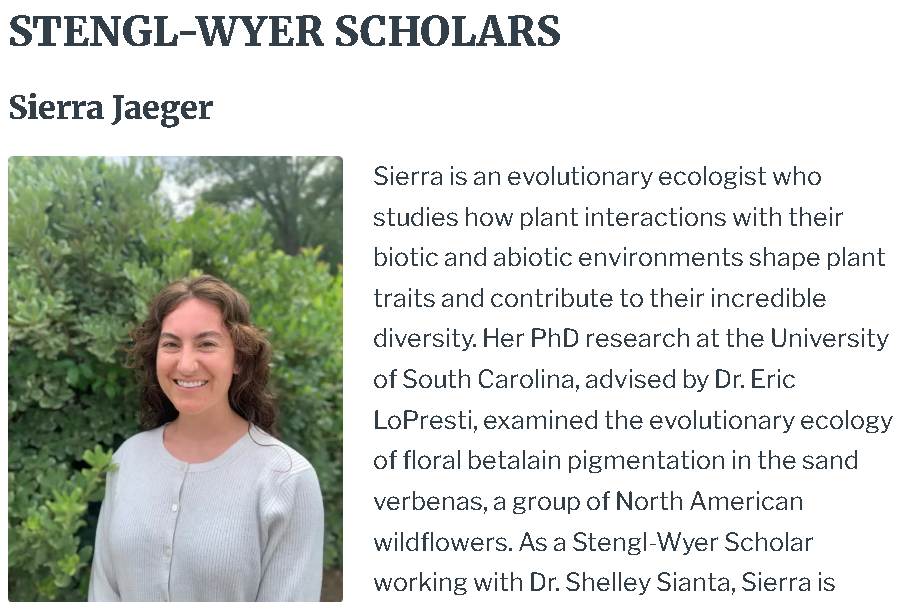
In 2026, Jaeger was named a Stengl-Wyer Scholar at the University of Texas at Austin, a postdoctoral research appointment supporting innovative work in biodiversity science.
Working with evolutionary biologist Shelley Sianta, Jaeger is expanding her research from wildflowers to cacti.
Cacti offer an intriguing scientific opportunity. Their flowers, fruits, and stems can display dramatically different colors, raising questions about whether pigmentation serves different evolutionary purposes throughout the same organism.
A colorful flower might attract pollinators. A brightly colored fruit might encourage animals to disperse its seeds. Pigmentation in a stem might help a plant cope with environmental stress.
But which explanations actually hold true?
Through field experiments and comparative evolutionary analysis, Jaeger will investigate these possibilities and explore how different ecological pressures have contributed to the diversity of cactus coloration.
The project brings together the various threads of her earlier research while opening new avenues for understanding plant evolution.

Seeing the Extraordinary in the Ordinary
There is something compelling about a scientific career devoted to understanding features of nature that most people pass without a second thought.
A wildflower growing beside a road, a cactus flowering in the desert, or a seed covered in sand can appear unremarkable. Yet each carries the accumulated consequences of countless generations of interaction with its environment.
Jaeger’s research serves as a reminder that biodiversity is more than a collection of different species. It is the product of an ongoing relationship between organisms, their surroundings, and the other forms of life with which they share the planet.
As artificial lighting, habitat changes, and shifting climatic conditions reshape those relationships, understanding how plants respond to their environments becomes increasingly relevant.
For Sierra Jaeger, a flower is more than a flower. Its color, shape, and behavior are pieces of evidence in a much larger evolutionary story.
And sometimes, understanding the extraordinary complexity of the natural world begins with asking why a single flower is pink.